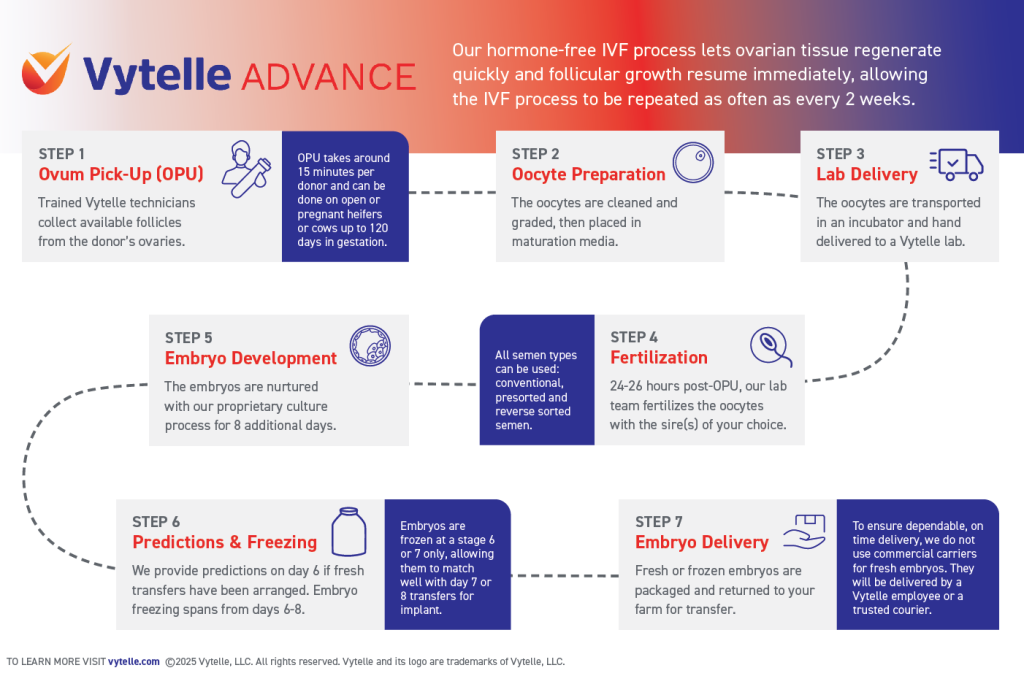
This graphic outlines the bovine OPU/IVF process from follicle collection through embryo delivery using a hormone-free system designed for efficiency and repeatability. The process begins with Ovum Pick-Up (OPU), where trained technicians collect available follicles from donor cows or heifers, including open or pregnant females up to 120 days in gestation, in a procedure that typically takes about 15 minutes per donor. Collected oocytes are then cleaned, graded, and placed into maturation media before being transported in an incubator to the IVF laboratory. Approximately 24–26 hours after OPU, the oocytes are fertilized using the sire or sires of choice, with flexibility to use conventional, sex-sorted, or reverse-sorted semen. Resulting embryos are cultured under proprietary conditions for several days, monitored for proper development, and evaluated for quality. By days 6 through 8, embryos are either prepared for fresh transfer or cryopreserved at the appropriate stage, allowing precise synchronization with recipients. Final embryos are carefully packaged and delivered back to the client, ensuring reliable handling and optimal readiness for transfer.
Watch the Bovine OPU Process
OPU / IVF Timeline
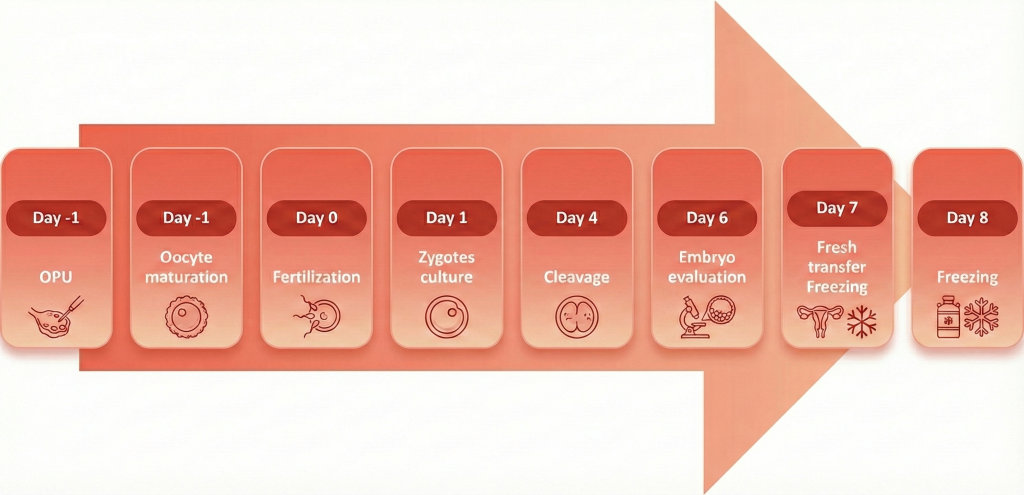
This OPU/IVF timeline outlines the controlled laboratory process used to produce high-quality bovine embryos from donor females. The procedure begins on Day -1 with Ovum Pick-Up (OPU), during which immature oocytes are collected directly from the donor cow’s ovaries using ultrasound guidance. Immediately following collection, these oocytes undergo in-vitro maturation, allowing them to reach the developmental stage required for successful fertilization.
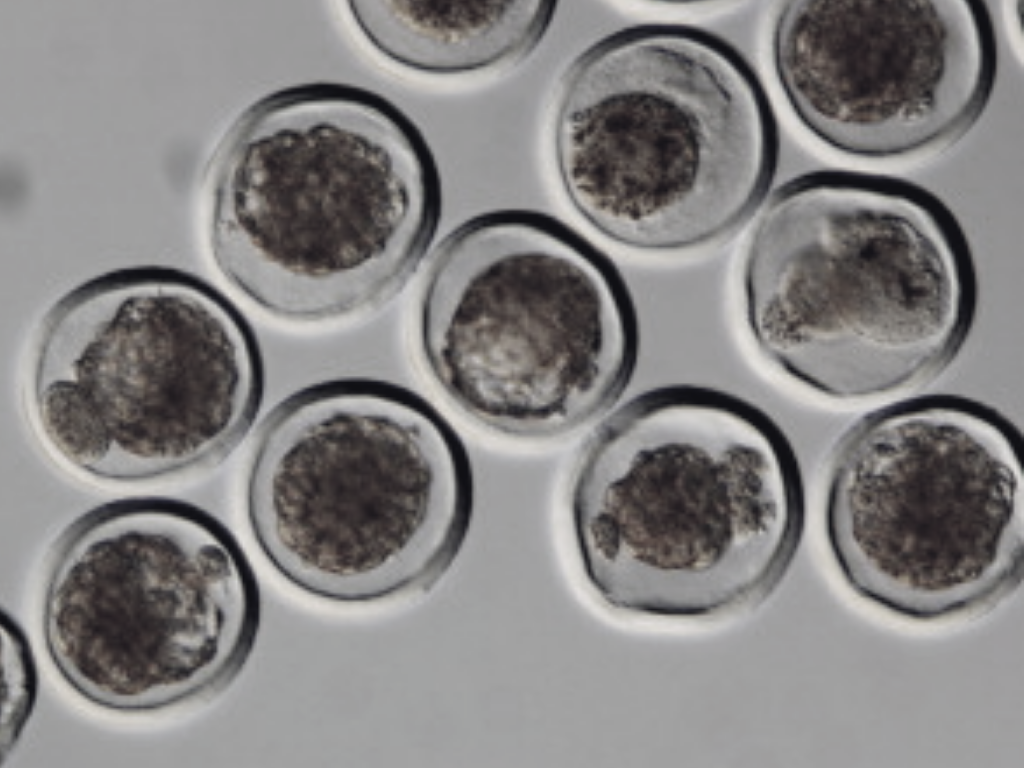
On Day 0, mature oocytes are fertilized in the laboratory using carefully prepared semen, marking the start of in-vitro fertilization (IVF). By Day 1, successfully fertilized oocytes develop into zygotes and are placed into specialized culture media that support early embryonic development. Over the next several days, embryos progress through normal cell division, known as cleavage, which is typically assessed around Day 4 to confirm proper growth and viability.
By Day 6, embryos reach more advanced developmental stages and are evaluated based on morphology and developmental quality. On Day 7, embryos that meet transfer or freezing criteria may be transferred fresh into synchronized recipient cows or prepared for cryopreservation. Any remaining viable embryos are frozen by Day 8, allowing them to be stored long-term and transferred at a later date, providing flexibility and maximizing the genetic potential of the donor cow.
IVF Embryos
Once IVF embryos are produced through the OPU and laboratory fertilization process, they are transferred into carefully synchronized recipient cows using established bovine embryo transfer (ET) protocols. These recipient females provide the uterine environment needed to support pregnancy, allowing embryos created from elite donor cows and superior sires to develop normally to term without additional reproductive demand on the donor. By leveraging ET, a single high-value donor can generate multiple pregnancies in one cycle, dramatically multiplying her genetic impact across the herd.
The integration of IVF and ET enables producers to advance herd genetics faster and more efficiently than conventional breeding methods. This approach improves selection intensity, shortens generation intervals, and increases the number of offspring from genetically superior animals in a given year. As a result, producers can accelerate gains in performance traits such as fertility, growth, carcass quality, and overall herd uniformity while maintaining flexibility in breeding and management decisions.
Benefits of Using OPU
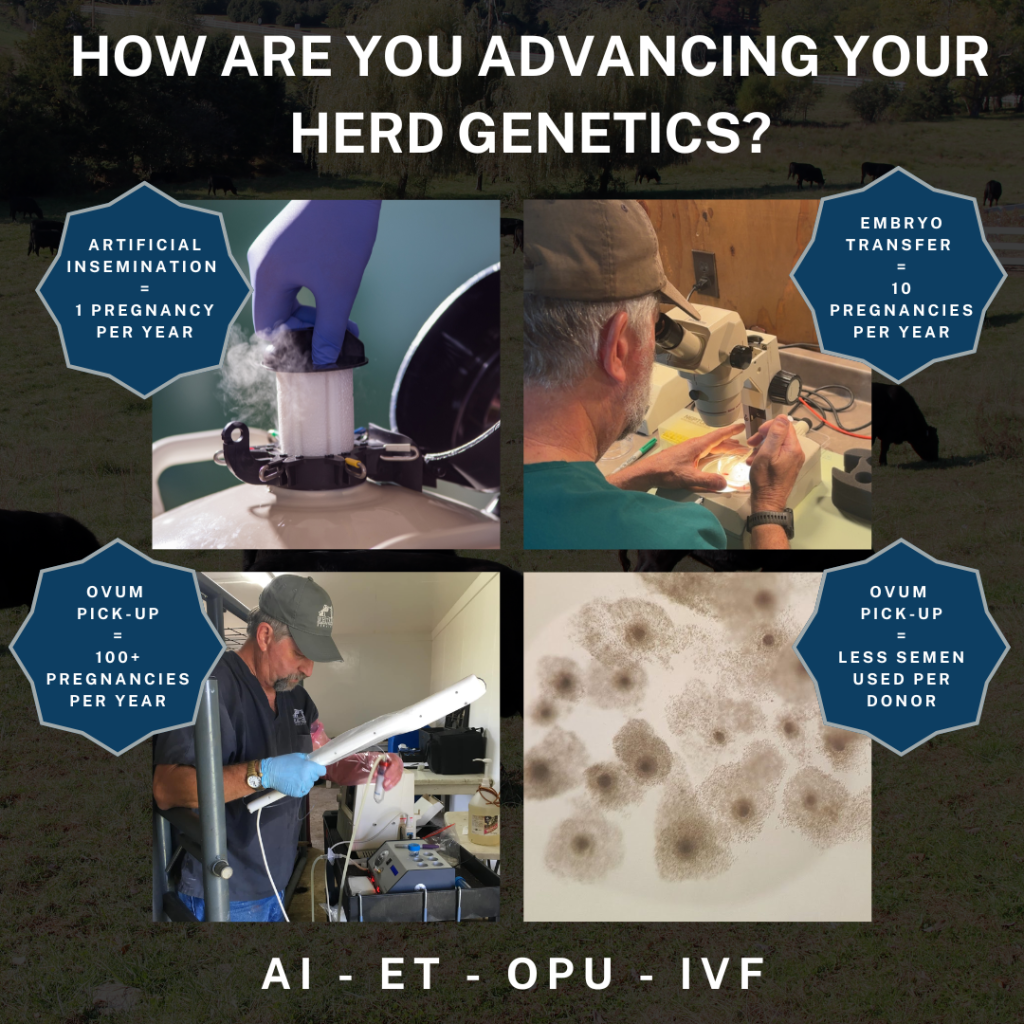
Using Ovum Pick-Up (OPU) to produce IVF embryos provides a powerful advantage for cattle producers seeking to accelerate and control genetic improvement within their herds. OPU allows multiple oocytes to be collected from elite donor cows in a minimally invasive procedure that can be repeated frequently, even in open or early-pregnant females, without the need for hormonal stimulation. Because IVF requires significantly less semen per embryo than conventional breeding, producers can efficiently leverage high-value or limited-availability sires while maximizing the genetic output of top donors.
Once fertilized in the laboratory, IVF embryos are transferred into carefully synchronized recipient cows through established embryo transfer (ET) protocols. This approach enables a single superior donor cow to produce dozens, or even hundreds, of pregnancies per year while recipient females carry the calves to term. By combining OPU, IVF, and ET, producers can dramatically increase pregnancy numbers, shorten generation intervals, improve herd uniformity, and rapidly expand desirable traits such as fertility, performance, and carcass quality across their operation.